Exam Name: Google Professional Machine Learning Engineer
Exam Code: Professional Machine Learning Engineer
Related Certification(s): Google Cloud Certified Certifications, Google Cloud Engineer Certifications
Certification Provider: Google
Actual Exam Duration: 120 Minutes
Number of Professional Machine Learning Engineer Practice Questions: 283 (updated: )
Q#1
You have a large corpus of written support cases that can be classified into 3 separate categories: Technical Support, Billing Support, or Other Issues. You need to quickly build, test, and deploy a service that will automatically classify future written requests into one of the categories. How should you configure the pipeline?
Q#2
You are training and deploying updated versions of a regression model with tabular data by using Vertex Al Pipelines. Vertex Al Training Vertex Al Experiments and Vertex Al Endpoints. The model is deployed in a Vertex Al endpoint and your users call the model by using the Vertex Al endpoint. You want to receive an email when the feature data distribution changes significantly, so you can retrigger the training pipeline and deploy an updated version of your model What should you do?
Q#3
You work with a team of researchers to develop state-of-the-art algorithms for financial analysis. Your team develops and debugs complex models in TensorFlow. You want to maintain the ease of debugging while also reducing the model training time. How should you set up your training environment?
Q#4
You are an ML engineer at a global shoe store. You manage the ML models for the company’s website. You are asked to build a model that will recommend new products to the user based on their purchase behavior and similarity with other users. What should you do?
Q#5
You are training an LSTM-based model on Al Platform to summarize text using the following job submission script:
Question Image
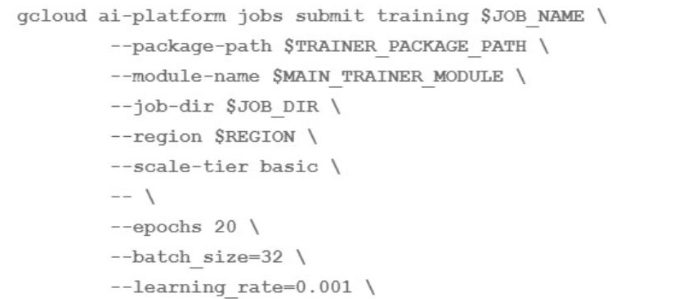
You want to ensure that training time is minimized without significantly compromising the accuracy of your model. What should you do?