Let me tell you right off the bat that earning AWS Certified Generative AI Developer Professional isn’t going to be an easy feat. You’re definitely not going to get it done by cramming over the weekend after watching some online tutorials or taking a few notes from a quick cheat sheet. However, if you put in the effort to earn the badge, it may very well become a turning point in your career.
It’s been proven that developers who started in mid-career roles as cloud engineers have transitioned into advanced positions as AI software engineers partially because of their success with earning this certification. The best part about this certification is that the study process for it will give you real skills that you can use in the workplace.
So let us get into it properly.
What Is This Certification, Really?
This AWS certification stands at the highest level in AWS’s hierarchy of certifications in AI. It is targeted at developers and engineers who create generative AI solutions utilizing AWS platforms, especially Amazon Bedrock, AWS SageMaker, as well as the other services which make the mentioned platforms applicable in an industrial context.
In its name, the word “professional” is not just ornamental for AWS. The company uses it to show the audience of the examination that it is assumed you have worked in cloud computing and artificial intelligence/machine learning before taking this test. You come to prove your ability to design, implement, evaluate, and protect systems involving LLMs.
The Amazon Bedrock is the center of all the topics covered in this exam. If you have not used Bedrock to interact with foundation models, create Knowledge Bases, configure Agents, etc., then you will immediately know that there was something important you didn’t do.
Before You Register, Ask Yourself This
But please do not let me discourage you from considering this exam, as it definitely isn’t something everyone will want to take for their first AWS certification attempt. There are two other certifications offered by AWS that may be better suited for beginners:
The AWS Certified Artificial Intelligence Practitioner is an excellent certification for beginners in this field or individuals looking for an easier option initially. The AWS Certified Machine Learning Engineer – Associate is a bit more difficult, focusing more on the SageMaker platform and the classic way of doing machine learning.
As far as taking this certification goes, it would probably make the most sense for you if you had previous experience building applications using AWS services and are interested in specializing in generative AI.
If that description fits you, keep reading. This guide is for you.
The Exam: What You Are Walking Into
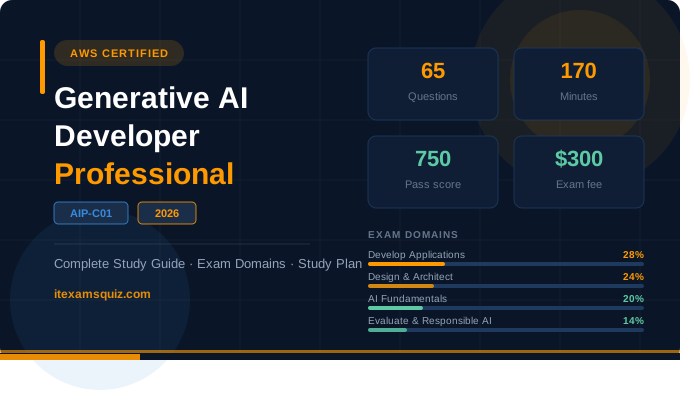
Here is the basic picture before we go deeper:
| Exam Code | AIP-C01 |
| Level | Professional |
| Questions | 65 |
| Time | 170 minutes |
| Passing Score | 750 out of 1000 |
| Format | Multiple choice + multiple response |
| Cost | $300 USD |
| Delivery | Pearson VUE — test center or online from home |
| Valid For | 3 years |
170 minutes for 65 questions sounds comfortable until you hit a scenario-based question that requires you to weigh four architecturally valid options against each other. These questions take time. Budget for them.
What the Exam Actually Tests
The exam is split across five domains. Here is the weight breakdown:
| Domain | Weight |
|---|---|
| Fundamentals of Generative AI on AWS | 20% |
| Design and Architect Generative AI Solutions | 24% |
| Develop Generative AI Applications Using AWS Services | 28% |
| Evaluate and Optimize Generative AI Solutions | 14% |
| Responsible AI and Security for Generative AI | 14% |
The Development domain at 28% is the biggest single chunk, which tells you something important: this exam rewards people who have actually built things, not just people who have read about building things.
Let me walk through each domain honestly.
Fundamentals of Generative AI on AWS (20%)
These are your foundational concepts. For this test, it is assumed that you have a good understanding of how large language models function conceptually – including tokenization, embeddings, the attention mechanism, context windows, and inference. This does not mean in-depth technical knowledge, but enough to allow you to understand questions related to concepts such as temperature and fine-tuned models vs base models with system prompts.
When it comes to AWS, you must know exactly what Amazon Bedrock is and which of its foundation models should be used in which circumstances. Whether it’s Amazon Titan, Anthropic Claude, Meta Llama, or Mistral, they all have their pros and cons and are meant to be applied differently according to their pricing and use cases. The test will require you to apply one of these foundation models to a specific situation.
The choice between real-time and batch inference is important here as well.
Design and Architect Generative AI Solutions (24%)
Here is where the exam challenges your architectural decision-making. You are not only expected to have knowledge on what each service does but rather which combination of services you need to use under particular circumstances and why certain architecture is preferred over other in specific scenarios.
Retrieval-Augmented Generation (RAG) plays an important role within the domain as well. You will be required to be able to build a proper RAG architecture without blinking your eyes: data ingestion into Amazon OpenSearch Service or Aurora with pgvector, embeddings generation, retrievals, and then injecting results into the foundation model prompt. Be aware of the trade-offs between different vector stores.
Multi-agent architectures constitute another important subject that candidates tend to underestimate. Bedrock agents, their coordination and how they employ Lambda functions as action executors – this is what will be asked from you more often than it would be shown by any preparation materials.
Pricing design is yet another topic relevant to the domain. AWS wants professionals to take into account pricing in the process of designing the architecture and not after.
Develop Generative AI Applications Using AWS Services (28%)
The most weighty category that sets apart candidates with practical experience from those having learned everything from theoretical material.
It is important that you understand how to invoke the Amazon Bedrock API via Boto3. It is crucial to know the details: how does streaming work, how can you manipulate parameters and responses, etc.
The knowledge about prompt engineering is evaluated through the use of specific techniques like zero-shot prompting, few-shot prompting, and chain-of-thought prompting. You will have to specify when each of these techniques should be used and how to apply them when sending requests to an API.
Bedrock Agents with customized Lambda actions, knowledge bases based on your documents, fine-tuning models on SageMaker, and other similar topics are also valid. Managing conversation memory when working with stateless foundation models is another interesting task. DynamoDB is usually mentioned within this category.
Evaluate and Optimize Generative AI Solutions (14%)
This may not seem like much, but students who fail to pay attention to this area because of its lack of excitement are losing points that they shouldn’t be losing.
Testing will include evaluation of the Bedrock Model Evaluation functionality know how to use it, the types of metrics generated by this function, and how to interpret them to guide you in selecting models or prompting change to them.
Hallucination is something to be taken seriously. The test asks questions concerning methods of reducing it: prompt engineering, RAG for using factual sources to ground the answers, guardrails to detect inappropriate output. Be familiar with each type of solution.
Cost Optimization through Inference is another subject matter covered by the exam. Compare provisioned versus on-demand billing in Bedrock, situations where batch inference is more cost-effective, and caching as a way to cut costs in high-inference scenarios.
Responsible AI and Security for Generative AI (14%)
It is sometimes treated as “soft.” Not at all. The test is rigorous on this point, especially with Amazon Bedrock Guardrails.
It is important that you understand how Guardrails are implemented: configuration of topic filters, content blocking, and handling of denied requests in your code. This is not theoretical, but practical knowledge.
Data privacy is also addressed. What happens when you pass information into foundation models API? Is there any logging? How can you set up your Bedrock environment according to the data residency requirements? How can you employ VPC endpoints to ensure that your data is not passing through the public network?
For regulated sectors like healthcare, finance, law, there are also compliance issues addressed in the test. You should be aware of which controls are provided by AWS and which require your configuration effort.
The Services That Matter Most
It won’t work to take an otherwise generic AWS certification and add some machine learning knowledge on top. The knowledge has to be very specific.
Amazon Bedrock is where you will need to know everything, down to implementation details. You will need to know foundation models access, Agents, Knowledge Bases, Guardrails, Model Evaluation, and Converse API. Everything but the kitchen sink!
Amazon SageMaker is important mostly for use cases when custom fine-tuning is required and for how to make use of SageMaker along with Bedrock in hybrid architectures. At least some basics about SageMaker JumpStart are useful to know for deploying out-of-the-box models.
Amazon OpenSearch Service provides the key story when it comes to vector databases on AWS. Be prepared to learn vector indexing concepts, kNN search settings, and the specifics of storing embeddings for semantic search in RAG workflows.
And AWS Lambda? It’s the key ingredient in most serverless machine learning applications on AWS. Learn how to call Bedrock models from Lambdas, manage streaming responses to lambda execution limits, and create architectures that won’t run into the timeout issue of Lambda.
And in addition to those, get familiar with Amazon S3 (artifact storage), DynamoDB (state of the conversation), API Gateway (exposure of AI APIs), CloudWatch (monitoring), IAM (access control), and Step Functions (workflow orchestration).
A Realistic Study Plan
Ten weeks works well for most candidates who are coming in with solid AWS experience but limited Bedrock exposure. Adjust based on where you are starting.
Weeks 1 and 2 – Close the gaps. Conduct a self-audit to see where you stand on your AWS skills. If you need more clarity on network services, IAM, or basic computation services, then invest some effort there. For AI/ML, it is important that you truly understand the concept of transformers and inference processes.
Weeks 3 through 5 – Live inside Amazon Bedrock. This part should not be limited to reading. You will require an AWS account that has Bedrock provisioned and you will be required to construct something. Call various foundation models and compare their results. Construct a RAG model that utilizes your own data source. Make use of Bedrock Agent with a Lambda Action. Create Guardrails for yourself. Run a Model Evaluation. This is when you gain experience that will prepare you for exam questions.
Weeks 6 and 7 – Think in architectures. Forget about single-point solutions and think about systems. Design full-fledged solutions like document Q&A, a memory-enabled customer service bot, and semantic search capabilities. After that, develop them. In essence, the exercise of making architectural choices such as choosing a vector database and a deployment strategy as well as considering the failure aspect is precisely what is tested in the Architecture exam.
Week 8 – Evaluation, optimization, and responsible AI. One week is enough to understand why prepared candidates still end up losing their points for these two 14% domains. Learn about Guardrail configuration and Bedrock Model Evaluation results as well as how to decrease hallucinations. Understand everything about Bedrock pricing in detail.
Weeks 9 and 10 – AIP-C01 Exam practice. Actual timed practice exams. For all your mistakes, understand not only what the right answer is but also how it came to be right, and why every other possible answer is wrong. Once you can score above 80% regularly, book your test.
💡 Quick Tip: During Weeks 9 and 10, don’t just rely on random question banks. The practice questions on ITExamsQuiz.com are mapped directly to AIP-C01 exam domains, so you can instantly spot which areas need more work instead of studying blind. A lot of candidates waste their final prep weeks on generic questions that don’t reflect what actually shows up on the professional-level exam domain-specific drilling is what moves the needle.
On Exam Day
Reread each question twice. Professional AWS test questions will try to trick you because you’re reading too quickly. Phrases like “most cost-efficient,” “minimal operation overhead,” and “highest fault tolerance” are not there for flavor; they decide the answer.
When you get stuck, use elimination. In almost every situation, you can see which answers are incorrect at first glance. Limit your options to just a few, and pick the most probable one from those left over.
Native AWS technology is favored when in doubt. When one answer leverages AWS’s own Bedrock technology, while another creates the exact same solution using open-source technologies deployed on EC2, the former is likely the preferred answer.
Mark uncertain questions and proceed. You’ve got more time than many AWS exams, but it’s foolish to waste ten minutes figuring out one difficult question on the first go-round.
Answer all questions. Even if you’re unsure, guess. A wrong guess costs you no penalty marks, but a blank answer is still worth zero points.
What This Opens Up
The shortage of engineers capable of building AI production systems on Amazon Web Services is real. The companies that want them include well-financed start-ups designing AI native applications as well as larger organizations trying to integrate AI into legacy systems, all at a high cost due to their scarcity.
Some of the roles this credential positions you for:
Generative AI Engineer – building the actual AI applications. This is the fastest-growing engineering job title of the last two years and shows no signs of slowing.
AI Solutions Architect – designing how enterprises structure their AI systems. Combines technical depth with the ability to translate requirements into architectures that work in practice.
ML Platform Engineer – building the internal tooling that lets AI teams move fast. Less visible, but very well compensated and in high demand at larger organizations.
Cloud AI Consultant – advising clients on generative AI strategy and implementation. Good fit if you enjoy variety and working across industries.
What You Can Expect to Earn
| Role | Salary Range (USD, 2026) |
|---|---|
| Junior Generative AI Developer | $95,000 – $130,000 |
| Mid-Level Generative AI Engineer | $130,000 – $170,000 |
| Senior Generative AI Engineer | $170,000 – $220,000 |
| AI Solutions Architect | $160,000 – $230,000 |
| ML Platform Engineer | $150,000 – $200,000 |
| AI Technical Lead | $190,000 – $260,000+ |
These numbers reflect actual market demand. Supply has not caught up yet, and that gap is keeping compensation elevated.
Mistakes Worth Avoiding
Perhaps the costliest mistake would be to think of it as a reading exam. This is not a reading test. Students that bypass building Bedrock capabilities through practical application of concepts and stick to documentation alone usually fail. Real-world experience cannot be overemphasized.
Secondly, there are people that do not pay enough attention to Bedrock agents. Concepts such as multi-agent orchestration patterns appear in various aspects including architecture, development, and optimization. This should be treated as a critical part of the syllabus.
Another area where people miss out on is Responsible AI and Guardrails. Understand how to configure Guardrails rather than just appreciating the philosophy behind them.
Finally, do not overlook prompt engineering. This may sound like it requires softer skills, but it has concrete techniques which need to be mastered. Examples include knowing the distinction between zero-shot and few-shot prompting, situations that require chain-of-thought reasoning, and the change that comes into play with RAG.
Quick Answers to Common Questions
How long should I prepare? Six to ten weeks is realistic for someone with solid AWS experience. Less if you are already working with Bedrock daily. More if you are newer to AWS fundamentals.
Do I need other AWS certifications first? No hard prerequisites. But if your AWS fundamentals are shaky, getting the Developer Associate or Solutions Architect Associate first makes this preparation significantly smoother.
Python or something else? Python. Specifically Boto3, the AWS SDK for Python. Almost every exam scenario is written around Python-based development.
Online or test center? Both are available through Pearson VUE. Online requires a quiet room with a webcam and stable internet. Test centers work fine if you prefer a controlled environment.
What if I fail? Retakes cost another $300. Most candidates who fail the first time and do another 2-3 weeks of targeted preparation pass on the second attempt.
The Bottom Line
Is it worth it? For the right person, absolutely yes.
For those developers who are interested in solving real problems, creating real solutions, and getting fairly compensated for doing that – being a specialist in AWS generative AI is definitely a good choice for the year 2026. Certification itself won’t give you any skills, but you will earn them throughout your preparation period, and certification will serve as proof that you did it.
$300 and a huge amount of preparation work. As a result, you get skills, which can be used right away, and certification that will help you stand out from others in a market with an imbalance between supply and demand for such specialists.
That is a trade worth making.
Looking for practice questions and study resources for the AWS Certified Generative AI Developer Professional? ITExamsQuiz.com has you covered updated, accurate, and built to actually prepare you for what the exam tests.
1 Comment
williams
May 28, 2026thanks! good info i utlize AIP-C01 exam practice from itexamsquiz during my prep